
Binomial Theorem(Part-4)
Comments:0Views:14Shares:0

Pascal’s Triangle and the Binomial Theorem
Pascal’s Triangle is a triangular arrangement of numbers that provides the coefficients for the expansion of a binomial expression (a+b)n. Each number in the triangle is obtained by adding the two numbers directly above it, while the numbers on the edges are always 1.
The first few rows of Pascal’s Triangle are:
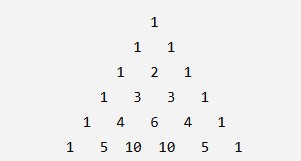
Relationship with the Binomial Theorem
The coefficients in the expansion of (a+b)n are taken directly from the nthn^{\text{th}}nth row of Pascal’s Triangle.
For example:
- (a+b)2=a2+2ab+b2 → Coefficients: 1, 2, 1
- (a+b)3=a3+3a2b+3ab2+b3 → Coefficients: 1, 3, 3, 1
- (a+b)4=a4+4a3b+6a2b2+4ab3+b4 → Coefficients: 1, 4, 6, 4, 1
Applications of Pascal’s Triangle
- Finding coefficients in binomial expansions.
- Solving combinatorics problems.
- Calculating probabilities.
- Studying number patterns and mathematical sequences.
- Simplifying algebraic computations.
Conclusion
Pascal’s Triangle is a simple yet powerful mathematical tool. It provides a quick and efficient way to determine binomial coefficients, making the expansion of binomial expressions easier and helping students understand the deep connection between algebra and combinatorics.

सुझाव दिनुहोस्
0 प्रतिक्रियाहरू