
| |

Binomial Theorem(Part-4)

Comments:0Views:14Shares:0

Pascal’s Triangle and the Binomial Theorem

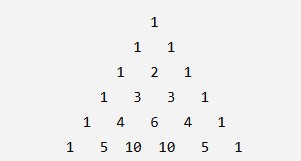
Pascal’s Triangle is a triangular arrangement of numbers that provides the coefficients for the expansion of a binomial expression (a+b)n(a+b)^n(a+b)n. Each number in the triangle is obtained by adding the two numbers directly above it, while the numbers on the edges are always 1.

The first few rows of Pascal’s Triangle are:
Relationship with the Binomial Theorem

The coefficients in the expansion of (a+b)n(a+b)^n(a+b)n are taken directly from the nthn^{\text{th}}nth row of Pascal’s Triangle.

For example:

  • (a+b)2=a2+2ab+b2(a+b)^2 = a^2 + 2ab + b^2(a+b)2=a2+2ab+b2 → Coefficients: 1, 2, 1
  • (a+b)3=a3+3a2b+3ab2+b3(a+b)^3 = a^3 + 3a^2b + 3ab^2 + b^3(a+b)3=a3+3a2b+3ab2+b3 → Coefficients: 1, 3, 3, 1
  • (a+b)4=a4+4a3b+6a2b2+4ab3+b4(a+b)^4 = a^4 + 4a^3b + 6a^2b^2 + 4ab^3 + b^4(a+b)4=a4+4a3b+6a2b2+4ab3+b4 → Coefficients: 1, 4, 6, 4, 1

Applications of Pascal’s Triangle

  • Finding coefficients in binomial expansions.
  • Solving combinatorics problems.
  • Calculating probabilities.
  • Studying number patterns and mathematical sequences.
  • Simplifying algebraic computations.

Conclusion

Pascal’s Triangle is a simple yet powerful mathematical tool. It provides a quick and efficient way to determine binomial coefficients, making the expansion of binomial expressions easier and helping students understand the deep connection between algebra and combinatorics.
यो खबर पढेर तपाईंलाई कस्तो महसुस भयो ?

सुझाव दिनुहोस्

0 प्रतिक्रियाहरू
अहिलेसम्म कुनै प्रतिक्रिया छैन। पहिलो प्रतिक्रिया दिनुहोस्।

Similar Posts

  • आजको युगमा MATH LAB को सान्दर्भिकता

    💬Comments:0|◉Views:5|↗Shares:0 Basanta Kumar Khanal २० असार २०८३ परिचय शिक्षण सिकाइको आधुनिक अवधारणाले विद्यार्थीलाई केवल सैद्धान्तिक ज्ञान दिनुभन्दा पनि अनुभव, प्रयोग र खोजमार्फत सिकाइलाई प्रभावकारी बनाउन जोड दिएको छ। विशेषगरी गणितजस्तो विषय, जसलाई धेरै विद्यार्थीले कठिन र अमूर्त ठान्छन्, त्यसलाई सहज, रोचक र जीवनोपयोगी बनाउन Math Lab (गणित प्रयोगशाला) को भूमिका अत्यन्त महत्त्वपूर्ण हुँदै गएको छ।…

  • |

    Complex number

    💬Comments:0|◉Views:34|↗Shares:1 Sudip Khanal २० साउन २०८३ Complex Numbers – Class 12 Mathematics (CDC Nepal) Complex Numbers is an important chapter in the Class 12 CDC Mathematics curriculum. It extends the real number system by introducing the imaginary unit (i=\sqrt{-1}) and explores numbers in the form (a+bi). This chapter provides the foundation for advanced mathematics, engineering,…

  • गणित शिक्षण: चुनौती कि अवसर?

    💬Comments:0|◉Views:4|↗Shares:0 Basanta Kumar Khanal २० असार २०८३ परिचय शिक्षा मानव विकासको आधार हो, र शिक्षाका विभिन्न विषयमध्ये गणितलाई विशेष महत्त्व दिइन्छ। विज्ञान, प्रविधि, इन्जिनियरिङ, अर्थशास्त्र, वित्त, सूचना प्रविधि तथा दैनिक जीवनका अनगिन्ती कार्यमा गणितको प्रत्यक्ष प्रयोग हुन्छ। यति महत्त्वपूर्ण विषय भए पनि धेरै विद्यार्थीले गणितलाई कठिन, जटिल र डर लाग्ने विषयका रूपमा लिने गरेका छन्।…

  • |

    Permutation Simulation for Grade 12 Mathematics

    💬Comments:0|◉Views:8|↗Shares:0 Basanta Kumar Khanal २२ असार २०८३ Permutation Simulation is an interactive learning approach that helps students understand how objects can be arranged when the order of arrangement is important. Through simulations, learners can create different arrangements, observe patterns, and compare the results with the mathematical formula for permutations. Permutation Simulation Fullscreen Facebook WhatsApp Messenger…

  • | |

    Counting Principle Simulation for Grade 12 Mathematics

    💬Comments:0|◉Views:11|↗Shares:0 Basanta Kumar Khanal २२ असार २०८३ Counting Principle Simulation is an interactive approach that helps students understand the fundamental principles of counting through visual and practical activities. Instead of memorizing formulas, learners can explore different counting situations by performing simulations and observing the outcomes. In Grade 12 Mathematics, counting principles are essential for solving…

  • | |

    Binomial Theorem(Part-3)

    💬Comments:0|◉Views:11|↗Shares:0 Basanta Kumar Khanal ३२ असार २०८३ A binomial coefficient is the numerical factor that appears in each term of a binomial expansion. It represents the number of ways to choose rr objects from a set of nnn distinct objects and is denoted by (nr)\binom{n}{r}. The formula for the binomial coefficient is:(nr)=n!r!(n−r)!\binom{n}{r}=\frac{n!}{r!(n-r)!}where n!n! (read as…